
Feature image by Ahmed akacha
HOF — After 14 years of war in Syria, here’s the hardest lesson I’ve learned:
The real war isn’t between you and your enemy. It’s inside you—between the part that wants to fight and the part that wants to compromise. Victory only comes when the will to compromise leads even the will to fight. Because only then can you reach the same part in your opponent.
In 2011, I was finishing my BA studies and preparing to emigrate to the United States. Then the Arab Spring broke out. Like many young Syrians, I was pulled away from personal plans into something larger: protests against the Assad regime. We were a scattered minority, yet we felt unstoppable. Our banners and chants seemed like warplanes; our marches in small alleys felt like aircraft carriers. What we were really fighting for was simple, and at the same time immense: freedom and dignity.
But reality hit fast. By the end of 2011, the peaceful phase was over. The regime crushed our demonstrations, and Syria slipped into civil war. We had to face a brutal paradox: though our movement was unstoppable, the Assad regime was immovable. The truth we hated to admit was that Assad, despite his corruption and oppression, had deeper roots of support in the cities, the army, and the bureaucracy than we did.
Even Assad, however, could not hold on unbroken. He didn’t absorb us; he cracked because of us. What followed was the slow collapse not just of his regime but of the state itself. By the end, the country was shattered, its institutions gone, its national achievements erased.
Then the Islamists came to power, promising the opposition freedom and dignity, and promising Assad’s loyalists the preservation of Syria’s national order and cohesion.
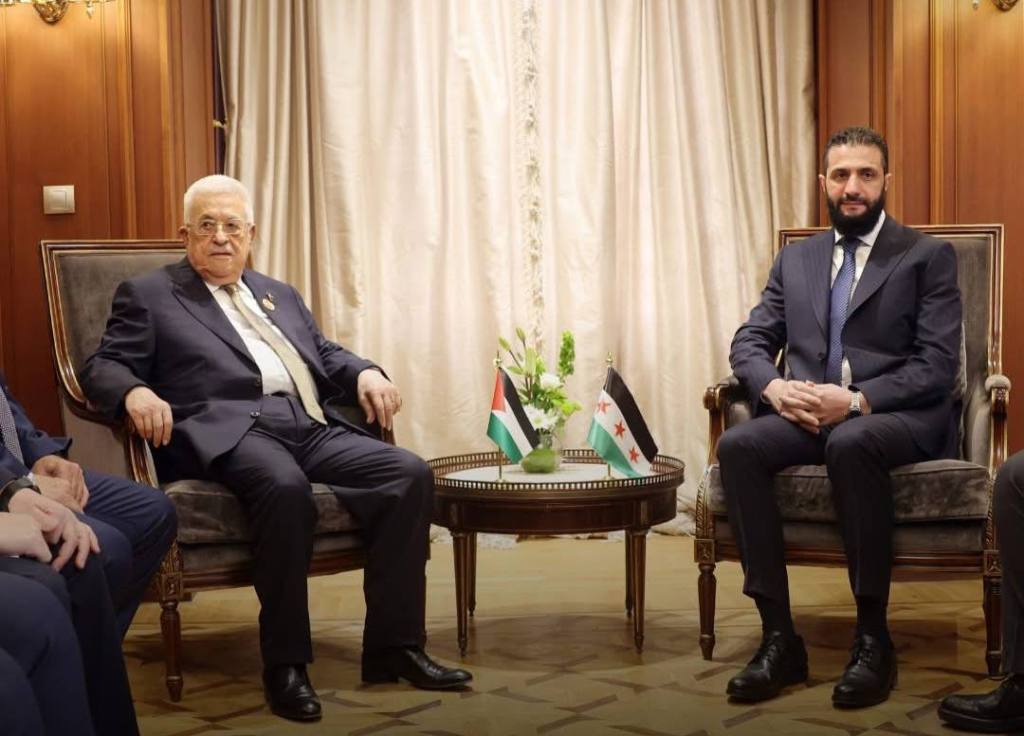
In practice, they rose from the chaos, kept the Baathist-era name Syrian Arab Republic to project continuity, adopted the uprising’s flag as camouflage, and seized power. For them, symbols of national identity mattered little except as tools of disguise. This became obvious when their new president, Ahmad al-Shara’a (once known as Abu Muhammad al-Julani), received Palestinian Authority leader Mahmoud Abbas: the Syrian flag on the table between them was upside down.
So in the end, nobody won. The state lost its continuity. The people lost their freedom and dignity. The war consumed both.
Looking back, I realize Syria’s war was never only between the uprising and Assad, or between armies and militias. It was inside every actor, every group, every person. Each of us carried two forces: one pushing toward war, one toward compromise. Both wanted security and agency. But when the war-driven side of one entity met the war-driven side of another, the result was catastrophe—the unstoppable clashing with the immovable.
You could already hear this inner conflict in the slogans of 2011:
On the opposition side: “No Dialogue” with a Killer like Assad.
On the regime side: “[Keep] Assad — or we’ll burn the country.”
Both rejected compromise, both demanded total victory—and so the paradox hardened into war.
Today, I see echoes of this pattern elsewhere: young generations pressing for freedom, old institutions clinging to order. The battle is real, but its outcome need not repeat Syria’s tragedy. If we let the compromising side lead—not by silencing the fighter within us, but by teaching it to fight under the guidance of compromise—we stand a chance. That’s how the paradox resolves.
War without compromise is fire without form—pure destruction. But when steel enters the furnace, fire becomes a tool. It tempers, it shapes, it creates.
That’s how something is truly won.
Relevant links
When God Plays Dice with the Universe
The Thin Line Between Us And The Enemy
A Flag Without a People, for a People Without a Flag
Feature image:
Boy on Protest in Syria
Idlib, Idlib Governorate, Syria
by Ahmed akacha

 Roumani Line
One thought on “Unstoppable vs. Immovable: Syria’s True Battle”